Drawing in Diversity Workshop
Co-Creating Diverse and Representative Depictions
of Human-Robot Interactions
July 1–4, 2026 · London, UK
In-person and colocated with ICSR + ART 2026
About the workshop
Diversity and representativeness are crucial elements in depictions of human-robot interactions (HRI), from figures to diagrams to any graphical meta-material accompanying publications and other forms of knowledge-sharing. At present, there is no standard or open resource that provides the wealth of visual material needed to represent the breadth of HRI engagements, users, robots, embodiments, scenarios, contexts of use, or application domains. This may account for known representation biases in the user present in publications and meta-materials.
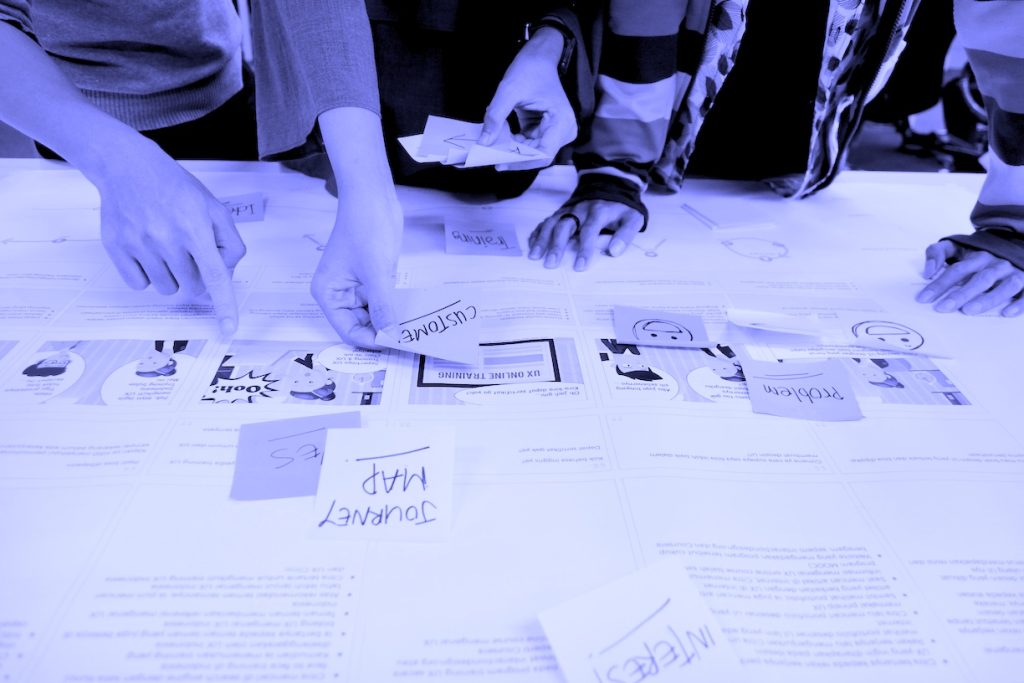
In this in-person half-day workshop, we aim to identify critical elements and sketch out possibilities, co-creating a wishlist for pictures and baseline meta-materials to be formalized into an open science resource for the social robotics and HRI community. The format will be creation-focused, with tangible contributions produced all attendees. Outcomes will be formalized into a free and open resource following a refinement and production stage. As a meta-research project, this workshop will address the calls for open science and diversity, equity, and inclusion, empowering the HRI community to represent the “human” side of the equation with accuracy and inclusivity. Note: No drawing skill required; the focus is on ideas, not artistic ability.
Discover our evidence-based motivation in:
Katie Seaborn and Özge Nilay Yalçın. 2026. Persona Non Graphica: Visual Representation Biases in Human-Robot Interaction Research. In Proceedings of the 21st ACM/IEEE International Conference on Human-Robot Interaction (HRI ’26). Association for Computing Machinery, New York, NY, USA, 216–226. https://doi.org/10.1145/3757279.3785541
Highlights
- 🛠️ Hands-on workshop! We’re deviating from the typical conference workshop format.
- 🎨 No drawing skills required! You don’t even have to draw anything! Bring your ideas and others will draw for you.
- 🌐 Open meta-research! Our ultimate goal is to produce free and accessible materials for the community of practice.
Team
Workshop organizers
We are a diverse group of early-to-mid career researchers working within or alongside social robotics and human-robot interaction who have a vested interest in meta materials and representation

Katie Seaborn
Associate Professor
University of Cambridge, UK / Institute of Science Tokyo, Japan
Özge Nilay Yalçın
Assistant Professor
Simon Fraser University, Canada
Yijia Wang
Ph.D. Student
Institute of Science Tokyo, Japan

Martina De Cet
Ph.D. Student
Chalmers University of Technology, Sweden

Shruti Chandra
Assistant Professor
University of Northern British Columbia, Canada
Mohammad Obaid
Associate Professor
Chalmers University of Technology, Sweden
Workshop
Schedule
ICSR 2026 will be held in-person at the University of London between 1-4 July 2026. The workshop will run on Wednesday, July 1st, 2026 from 14:00–17:00 (in Workshop Room 2). The tentative schedule is as follows:
- 14:00–14:05:
Setup and greetings - 14:05–14:20:
Introduction, including to representation biases, meta-research, and diversity - 14:20–15:00:
Brainstorm wishlist - 15:00–15:30:
Wishlist card sort and voting - 15:30–15:45:
Coffee break (and organizer vote counting) - 15:45–16:20:
Drawing activity - 16:20–16:50:
Exemplar drawings card sort and voting - 16:50–17:00:
Final remarks
The in-person workshop deviates from others with its hands-on format:
- 🧠 Brainstorm: Attendees will work together in small groups to brainstorm a list of elements typically represented in visual depictions of HRI, captured in text form on post-it notes.
- 🗒 Card-sorting and voting: Attendees will use a shared wall to display their post-it notes as “cards” and collaboratively organize and categorize these cards to eliminate repetition and identify key elements. Then, attendees will be given stickers to vote by consensus on the most important ideas.
- ✍ Drawing: Attendees will sketch out the most important ideas with provided drawing tools. They will experiment with style (e.g., iconic, realistic), perspective (e.g., top-down, profile), and colour palette. They will identify difficult-to-draw elements and remain alert to representation biases.
- 🗳️ Card-sorting and voting with the drawings as the focus.
Workshop
Outcomes
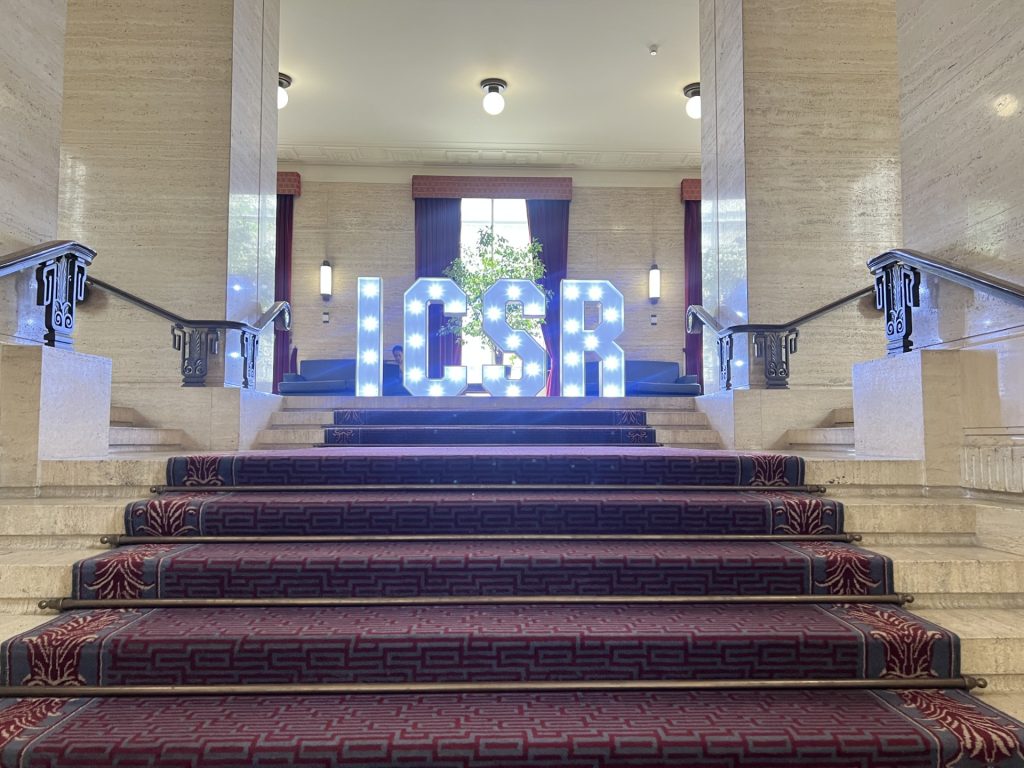
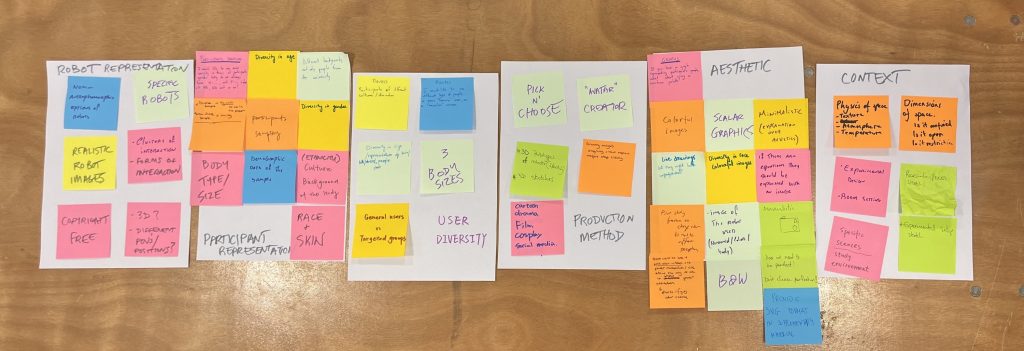
Thank you all for joining the workshop! We’re sharing a few photos and the outcomes from the brainstorming session here. The main needs for an open-source figure kit were identified as:
- Robot representation
- Participant representation
- User diversity
- Context representation
- Production methods options
- Aesthetic diversity
Workshop
Submission
We invite you to submit a brief ~1-page position statement in PDF form (using the ACM sigconf template), with half a page dedicated to a statement of interest, including any specific representation biases the applicant wishes to target, and half a page available for either a sample drawing or examples of representation biases that need to be addressed (from the applicant’s own work or that of others).
Submissions will not be posted publicly.
- Deadline: June 12th, 2026
- Confirmation of participation: June 16th, 2026
Conference
Registration
ICSR 2026 will take place in-person only at the University of London in London, UK during 1-4 July 2026. The workshop will run on Wednesday, July 1st, 2026 from 14:00–17:00 in Workshop Room 2.
Registration at the main conference is required. Please register via the ICSR ’26 portal.
Registration closed.
Contact us
Feel free to reach out about with any questions or comments.
drawingindiversityicsr@gmail.com

Updates
2026.7.11:
Added workshop outcomes.
2026.6.4:
We’ve extended the deadlines.
2026.4.18:
We’ve launched the second version of our website.
2025.12.11:
Our workshop was accepted at ICSR 2026.

FAQ
Can I drop in and out?
Yes, sure!
Do I have to draw?
No, you don’t have to draw. You can share ideas in any format that works for you, including writing, speaking, gesturing, sketching, or sharing existing work, to name a few. Also, the organizers and others can/will draw for you!